
Independent academic support for students studying at Imperial College London — not affiliated with or endorsed by the university. Learn more →
Summer Term 2026 workshops now live — securing places for Imperial’s April intake
Register today · Places limited per cohort
View pricing →
Imperial College London  ·  Summer Term 2026

Master the maths
Imperial demands of you.

PhD-led live workshops in every first-year mathematics subject — mapped to Imperial’s publicly available course syllabi. Seven subjects. Nine programmes. One academic community.

View all seven subjects
7
Subjects covered
9
Imperial programmes
18/7
PhD moderation
Live this term — register or pre-book
Calculus & Differential Equations
MATH40004 · ODEs, integration, multivariable methods
Live9/9 programmes
Linear Algebra
MATH40003 · Vector spaces, eigenvalues, transformations
Live9/9 programmes
Probability & Statistics
MATH40005 · Axiomatic probability, distributions, inference
Live9/9 programmes
Applied Maths & Modelling
MATH40007 · Mathematical frameworks across disciplines
Pre-register8/9 programmes
Vector Calculus
Foundations · Div, curl, Green’s & Stokes’
Pre-register8/9 programmes
Mechanics  ·  Real Analysis  + more
Opening Week 3 — register your interest now
Coming
Built for
Mathematics MSci · all variants
Mechanical Engineering MEng
Computing MEng · AI MEng
Physics BSc · MSci
Electrical & Electronic Engineering
Chemical Engineering MEng
Aeronautics MEng
University campus students studying
Imperial College London, South Kensington
Student working on a mathematics problem
Problem-solving sessions, every week
Academic facilitator teaching
PhD facilitators — 5,000+ tutoring hours each
Cross-programme coverage

Every Imperial STEM student.
Every core subject.

We mapped every first-year compulsory module across nine major Imperial STEM programmes. These seven subjects cover every student — whatever their degree.*

* Coverage confirmed from publicly available Imperial course pages. Module references used for descriptive purposes only.

9
major Imperial STEM programmes covered by core subjects
20K+
annual applicants across Imperial’s target STEM programmes
100%
syllabi mapped to Imperial’s publicly available course pages
28
live workshops per month in the complete suite
Imperial programmes covered per subject
Calculus & DEs
9/9
Linear Algebra
9/9
Probability & Stats
9/9
Applied Maths
8/9
Vector Calculus
8/9
Mechanics
6/9
Real Analysis
4/9
The curriculum

Seven subjects.
Every Imperial programme.

Every module mapped to Imperial’s publicly available first-year syllabi. Each subject includes 4 live PhD-led workshops per month, plus unlimited UMM Academic Community access with PhD moderation 18 hours a day, 7 days a week.

01
Universal — all programmes
Calculus & Differential Equations
From advanced integration through to ordinary and partial differential equations. Mapped to Imperial’s MATH40004 “Calculus and Applications” and the maths modules across Engineering, Physics and Computing.
All programmes · 9/9Live now
02
Universal — all programmes
Linear Algebra
Vector spaces, linear transformations, eigenvalues and diagonalisation. Mapped to Imperial’s MATH40003 “Linear Algebra and Groups” and Computing’s MATH40012 variant.
All programmes · 9/9Live now
03
Universal — all programmes
Probability & Statistics
Axiomatic probability, distributions, statistical inference and data modelling. Mapped to Imperial’s MATH40005 with extension depth for Maths+Statistics students.
All programmes · 9/9Live now
04
Engineering & Science track
Applied Mathematics & Modelling
How mathematics underpins science and engineering. Mapped to Imperial’s MATH40007 “Introduction to Applied Mathematics” and Year 1 maths modules across all engineering departments.
Engineering + Science · 8/9Pre-register
05
Engineering & Science track
Vector Calculus
Divergence, curl, gradient, Green’s theorem, Stokes’ theorem. Concepts taught across Year 1 Engineering and Physics modules, building toward MATH50004.
Engineering + Science · 8/9Pre-register
06
Engineering track
Mechanics & Classical Dynamics
Newton’s laws, stress analysis foundations, vibrations and fluid mechanics basics. Mapped to MATH94001 / MECH40009 and Year 1 modules across Mechanical Engineering, Physics, EEE, Aeronautics and Chemical Engineering.
Engineering track · 6/9Week 3
07
Pure Maths specialist
Real Analysis
Opening Week 3

The rigour that separates A-level from university mathematics. Limits, sequences, series, continuity and the formal foundations of calculus. Mapped to Imperial’s MATH40002 “Analysis I” — the module where most Maths, Physics and Geophysics students experience the sharpest difficulty spike in Year 1.

PhD moderators provide worked solutions in the UMM Academic Community 18 hours a day. Pre-register now to secure your place in the first cohort.

The experience

Live. Rigorous. PhD-led.

Not pre-recorded video. Not passive content. Every workshop is a live, problem-focused session led by a doctorate-level mathematician who knows your Imperial module — followed by 18-hour-a-day PhD moderation in the UMM Academic Community. Overnight questions answered by 9am.

01
Register & book
Choose your subjects from the full 7-course catalogue. Single subject, bundle, or complete suite. Pre-register for upcoming courses and receive first-access booking when they open.
02
Attend live workshops
Four live sessions per subject per month on the Wise Live platform. Small cohorts. Your Head Facilitator leads problem walkthroughs in real time. WhatsApp available for instant 1:1 communication with your facilitator.
03
Ask the community
Post questions to your subject forum in the UMM Academic Community. PhD moderators active 18 hours a day, 7 days a week. Overnight questions answered by 9am. Peer discussion, shared worked solutions, cross-cohort collaboration.
04
Watch back on demand
Every session recorded and available immediately. Rewatch problem walkthroughs before assessments. Your subscription includes the full term archive across all subjects you are enrolled in.
Why UMM is different

Not a tutoring service.
An academic community.

Most supplementary learning is passive, generic, and disconnected from your actual degree. UMM is built around Imperial’s real syllabi, live doctorate expertise, and a moderated peer community that learns together.

UMM Academic Community
PhD facilitators mapped to Imperial’s actual module syllabi
4 live workshops per month per subject — active problem-solving, not lecture replay
PhD moderation 18 hours a day — overnight questions answered by 9am
Peer cohort of Imperial STEM students — shared experience, cross-fertilisation of ideas
Subject-specific forums with searchable worked solutions and full thread history
Full session recordings available immediately after each workshop
Generic tutoring / pre-recorded platforms
Generic university maths — not mapped to any specific institution’s modules
Pre-recorded video — no interaction, no real-time problem-solving
Email or ticket support — responses measured in days, not hours
Individual tutoring — no peer community, no shared learning environment
No moderated forum — students isolated when stuck outside sessions
Recordings gated or unavailable after trial period
UMM Academic Community

Your questions answered
18 hours a day.

A moderated academic forum — subject-specific, PhD-supervised, and built for Imperial first-years. Post problems, share solutions, and learn from every cohort member’s questions. PhD moderators active 18 hours a day, 7 days a week. Overnight questions answered by 9am.

Subject forum
Moderator
Threads
Last activity
Calculus & Differential Equations  MATH40004
ODEs · Integration · Multivariable Calculus
PhD moderated · 18hrs/day
847
threads
Imperial problem sheet 3 — Q7 on separable ODEs, can’t isolate the variable
Maths Year 1 student
PhD response posted
24 replies
PhD Moderator2 hours ago
When does the chain rule extend to implicit differentiation of F(x,y,z) = 0?
Physics Year 1 student
Student discussion
11 replies
Engineering Year 15 hours ago
[Worked solution] Laplace transform method for second-order linear ODE — full walkthrough
Resource · Calculus & DEs
PhD authored
56 views
PhD ModeratorYesterday
Linear Algebra  MATH40003
Vector Spaces · Eigenvalues · Group Theory
PhD moderated · 18hrs/day
612
threads
Cayley-Hamilton theorem proof — where does the characteristic polynomial substitution come from?
Computing Year 1 student
PhD response posted
18 replies
PhD Moderator1 hour ago
Understanding quotient groups — I get cosets individually but not why G/H is a group
Maths Year 1 student
Student discussion
9 replies
Maths Year 13 hours ago
Probability & Statistics  MATH40005
Distributions · Statistical Inference · Axiomatic Probability
PhD moderated · 18hrs/day
534
threads
[Resource] Moment generating functions — derivations and key results for Imperial exam prep
Resource · Maths+Stats
PhD authored
41 views
PhD Moderator4 hours ago
Convergence of random variables — almost sure vs. in probability
Maths Year 1 student
Student discussion
7 replies
Stats Year 16 hours ago
Applied Maths · Vector Calculus · Mechanics · Real Analysis
Opening Week 2–3 · Pre-register to receive first-access notification
Opening soon
4
subjects
Latest activity across all subject forums
Sigma algebras — why are they needed for rigorous probability?
Maths Year 1 · Analysis
7 replies
12 min ago
Workshop 3 recording live — Stokes’ theorem worked examples now available
PhD team · Vector Calculus
Announcement
1 hr ago
Newton’s second law in non-inertial frames — how to approach the exam question?
Engineering Year 1 · Mechanics
5 replies
2 hr ago
Group learning

Where shared struggle becomes
shared mastery.

The students who thrive at Imperial are rarely those who study in isolation. The UMM Academic Community creates the conditions for cross-fertilisation of ideas — a cohort of first-years learning the same material, supported by the same PhD team, growing together.

01
Cross-programme cohorts
Maths students, engineers, physicists and computing students all face the same first-year mathematical challenges from different angles. Shared forums accelerate understanding in ways no individual tutoring session can replicate.
02
PhD-authored worked solutions
Every question posted receives a response from a doctorate mathematician — not a peer, not an automated system. Worked solutions are written to be reused, searched and referenced by every student in the cohort.
03
Ideas that bloom across subjects
A Mechanical Engineering student’s question about ODEs illuminates a method a Computing student hadn’t considered. A Maths student’s rigorous approach to convergence helps an engineer understand why their numerical method diverged.
<2hr
average PhD response time during active hours
18/7
PhD moderation — overnight questions answered by 9am
7
subject forums, each PhD-supervised
100%
questions receive a PhD worked solution
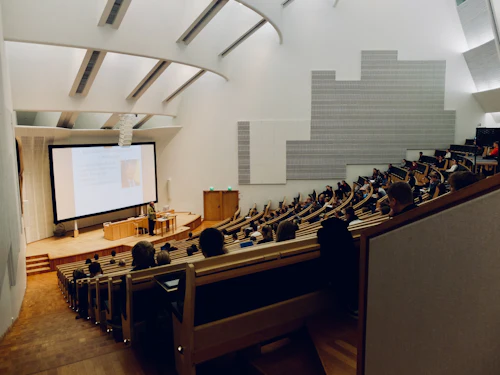
University lecture theatre
Live workshop sessions, weekly
Students collaborating on mathematics
Community learning across cohorts
Mathematical equations on a board
Rigorous mathematics — taught by those who live it
Academic leadership

Taught by those who have
lived it.

Every Head Facilitator holds a doctorate in their subject specialism with a minimum of 5,000 verified tutoring hours. Full academic team profiles and credentials will be published upon programme launch.

Founding Academic Director
Appointment in progress
PhD · STEM · 20+ years university-level teaching across Mathematics, Engineering and Applied Sciences · Curriculum oversight across all 7 UMM subjects
7subjects under academic oversight
Head Facilitator
Head Facilitator — Calculus
PhD Mathematician
PhD · Mathematics · 5,000+ verified tutoring hours · University-level teaching specialist
5K+tutoring hours
Head Facilitator
Head Facilitator — Linear Algebra
PhD Mathematician
PhD · Mathematics · 5,000+ verified tutoring hours · University-level teaching specialist
5K+tutoring hours
Head Facilitator
Head Facilitator — Probability
PhD Mathematician
PhD · Mathematics · 5,000+ verified tutoring hours · University-level teaching specialist
5K+tutoring hours

Full academic team profiles and credentials will be published upon programme launch.

Investment

One subject or all seven.
Your choice.

Every pricing tier gives you 4 live PhD-led workshops per month for each enrolled subject, plus full UMM Academic Community access with PhD moderation 18 hours a day. Register for more subjects and the per-subject cost falls.

Single subject
£180
per month · per subject
3+ subjects bundle
£299
per month · per subject · save £81
Complete suite (all 7)
£399
per month · all 7 subjects
Single subject
Focus
One subject, fully supported. Four live workshops per month plus unlimited Academic Community access for that subject.
£180
per month · per subject
Includes
4 live PhD-led workshops per month
Full session recordings, available immediately
UMM Academic Community — subject forum access
PhD moderation 18 hours a day for that subject
  • Cancel any month · no lock-in
  • Add additional subjects at any time
  • Upgrade to bundle or complete suite anytime
  • 14-day cooling-off right (UK Consumer Rights Act 2015)
Complete suite
All seven subjects
Every subject, every workshop, the full Academic Community. The complete Imperial first-year mathematical toolkit in one monthly subscription.
£399
per month · all 7 subjects · 28 workshops
Includes
28 live PhD-led workshops per month (4 per subject)
All 7 subject forums — full community access
PhD moderation 18 hours a day across all subjects
Priority booking as new subjects open
  • All 7 subjects — lowest effective cost per subject
  • Cancel any month · no lock-in
  • First access to new subjects and special sessions
  • Direct facilitator contact for complex questions
Who UMM is for

A platform built for everyone
in the Imperial ecosystem.

Students are our primary focus. But UMM also provides structured pathways for parents supporting their student, PhD mathematicians building their academic careers, affiliate partners, and campus representatives.

Primary
Students
First-year Imperial STEM students seeking live PhD support across all 7 core first-year mathematical subjects.
Supporting
Parents
Gift a term’s subscription. Understand what is being covered. Support your student through the critical first-year transition.
Partners
Facilitators
PhD mathematicians. Lead workshops at £100/hr, build your teaching career alongside your research, join a growing academic team.
Referral
Affiliates
Refer students. Earn £75 per seat enrolled. Affiliates with existing student networks earning £1,500+ per month. Join the programme →
Campus
Campus Reps
Be UMM’s presence at Imperial. Organise cohort sign-ups, run information sessions, earn per group enrolled.

Don’t wait until the exam
to understand it.

Imperial’s first year is designed to challenge you from Week 1. The students who thrive are those who build understanding in real time — not those who try to catch up in Week 10.

Week 1 workshops are already live. Register today and attend your first session this week. Or book a free 15-minute call with a facilitator via WhatsApp.

Free 15-min call →
Chat with us